
Meet John A. Valenti 3rd

John A. Valenti 3rd is a national award-winning reporter for the Long Island, New York, based daily newspaper Newsday, where he has worked since 1981. He is featured in the Emmy Award-winning ESPN 30-for-30 episode Big Shot and is the author of Swee'pea, The Story of Lloyd Daniels and Other Playground Basketball Legends, as well as a contributing poet to the critically acclaimed anthology 13 Poets from Long Island. For Nothing Is Hidden is his debut novel.

Please share a quick synopsis of For Nothing Is Hidden.
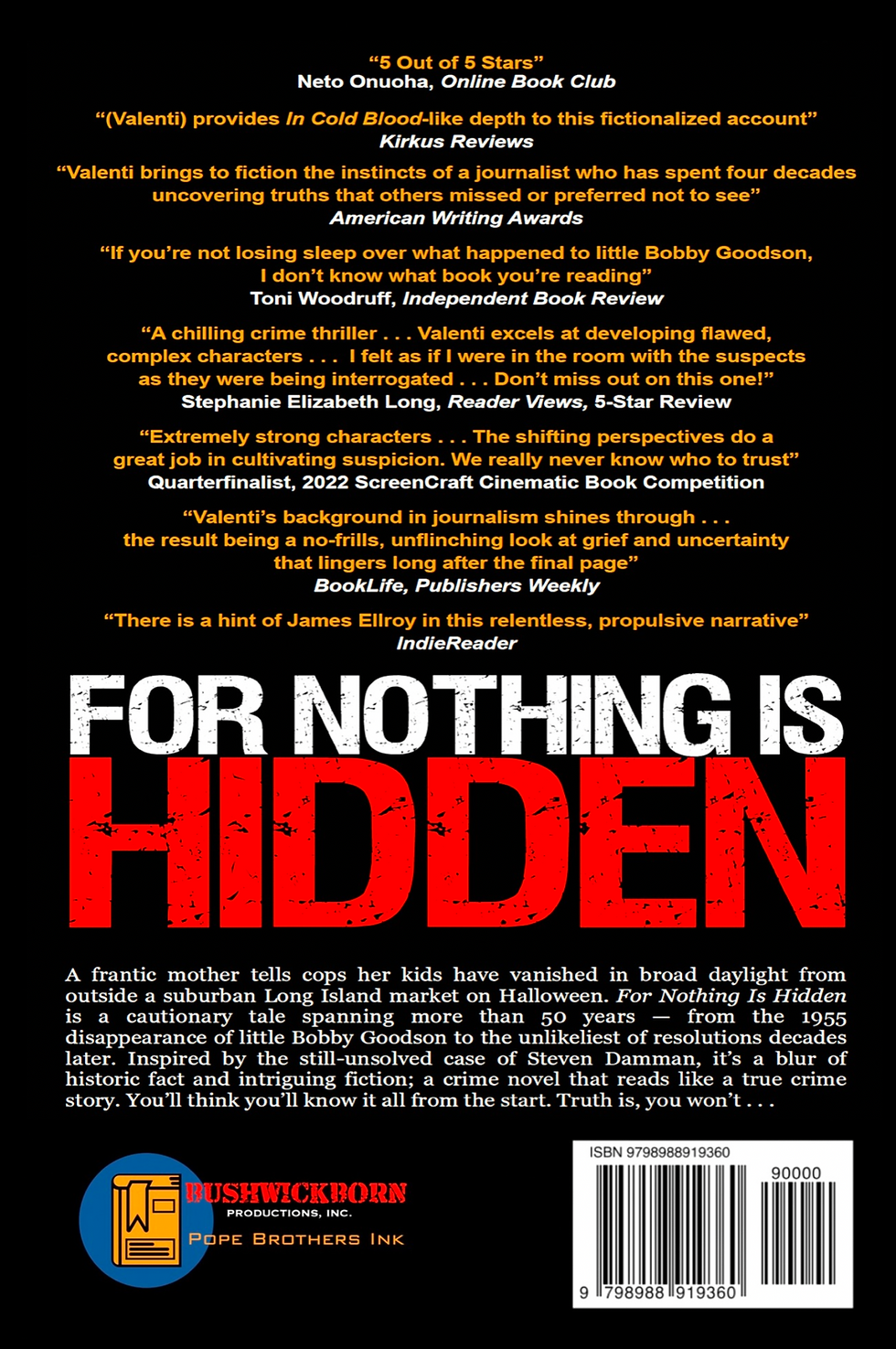
A frantic mother tells the cops her kids have vanished in broad daylight from outside a
suburban Long Island market on Halloween. Inspired by one of the oldest unsolved missing
child cases in U.S. history — the 1955 Halloween Day disappearance of then 2-year-old Steven
Damman from outside a storefront in East Meadow — For Nothing Is Hidden is a cautionary
tale spanning more than 50 years, from the disappearance of little Bobby Goodson to the
unlikeliest of resolutions decades later. You’ll think you’ll know it all from the very start . . .
Truth is, you won’t . . .

Photo Credit 1955 Nassau County Police Department Handout
What was it about the unsolved missing child case of Steven Damman that struck you and stuck with you enough to want to write a novel about it?
In 2009 a man named John Barnes from Kalkaska, Michigan, came forward to claim he was Steven Damman. The story broke in the Daily News, reported by John Marzulli, who I actually went to Hofstra with — and who later became the spokesman for the U.S. Attorney's Office for the Eastern District of New York. When the story broke Newsday had me reach out to Steven’s father, Jerry Damman — and I interviewed him via phone from his home in Newton, Iowa. I can’t explain what it was, but something about that conversation just struck me as odd . . . I don’t know if it was the detachment I felt on the part of Jerry Damman. Or if it was something else, altogether. He said all the right things: He hoped John Barnes really was Steven. He hoped he’d finally have answers. That said, I still felt there was something off. When DNA results determined Barnes wasn’t Steven Damman, fellow reporter Kathy Kerr and I FOILED the original NCPD file from the case, with paperwork beginning with the disappearance in 1955.
At that point, based on the files, I decided to write a novel.

The passages in your novel are filled with descriptions that not only transport the reader into each scene, but also transport them straight into the mid-1950s and beyond. How many research hours did you clock before or during the penning of your novel? Did you rely on some of your own experiences and memories from that time?
I wasn’t alive when Steven Damman went missing in East Meadow on Halloween Day, 1955. But, I recall my mom leaving me watching over my brothers outside stores while she shopped when I was little — and know moms everywhere thought nothing of it back then. So, that was a start to the randomness — and my thinking. Also, my cousins — and, my late ex-wife — all grew up in East Meadow. One of my cousins actually lives now about three or four blocks from where the real disappearance is claimed to have occurred. So, I knew the area.
That said, I’m a reporter. [I don't say that to be jerkish; more just to convey my mindset] . . . I did a ton of research into events of the day: pulled microfilm and online clips to see photos of the neighborhood — and, similar Long Island neighborhoods in the area — from back then; pulled newspaper coverage from the time period, to see what else was going on on Long Island and in the world at the time. That’s how I learned of the William Woodward Jr. shooting, which happened the day before, and how I learned of plane crashes, other missing child cases [including the Weinberger case] and I used all of that to build narrative, from the development of suburbia to the history of the police department to Roosevelt Field history, etc.
Some of that legwork — and, I did this researching Cottonwood Falls, the town in Kansas where my fictional couple was from, as well as other background in the novel — might’ve only led to a sentence. Or a reference. One phone call I made was to a spokesman for a Southern railroad. I spent 30 minutes with him on the phone. It led to one mention in the prologue: about a train in Panama City, Florida, hauling north to Dothan (Alabama) . . . to most folks it’s a throwaway. But being able to mention it makes the narrative real and helps transport a reader.
I even purchased old postcards from eBay — some with street scenes from Geneva, New York, so I could build the scene there from when Bobby Goodson is born. I pulled old maps, researched histories of towns, found things like Kenosha, Wisconsin, was once a car-manufacturing town; found Knute Rockne had been killed in a plane crash a stone’s throw from Cottonwood Falls (I knew he’d been killed in a crash; just not there) . . . I’d offer the role call of NCPD police officers killed in the line of duty — and, how they died — is all real. I scoured the NCPD history to find that, so I could build the scene when my fictional cops died.
I banked on accident and crime stories I’d covered over the years, on how those cops acted and talked, what the scenes were like. How our conversations went. How reporters talked to cops and vice-versa. What conversations were like in the newsroom. What the old Newsday offices were like back in the 1950s. I knew reporters and photogs who’d worked back then. I thought about how they acted, spoke. I also borrowed a lot from the investigative files — the interviews cops did with Jerry and Marilyn Damman about their missing son; the interviews they did with suspects and people they spoke with during their massive investigation. I even researched dialects, like specific language used to convey how Jake Johnson, the pilot from backwoods Appalachia, might’ve spoken back in 1955 . . .
Research is VERY time-consuming. But, my thought? You want to build a believable story with believable characters, you make all of it — and, them — as close to the realities as you can. You keep them anchored in truth . . .
Did your journalism background play a role in the writing of this novel?
So, yes. As explained above. As a reporter you interview tons of people — and, you get to roam around inside their heads, learn what makes them tick; how they might act in a given situation and how they answer questions might lead to truth or confusion about truth; how they might lie — and so that all went in to how I developed the characters.
Having done this job in various capacities for more than four decades lent to my thinking about what was needed to build realism into the scenes and how characters acted, too. And I purposely wrote the novel as I did to give it the feel of a true crime story, but also to keep from telling a lie to the readers about what had really happened to little Bobby as the book went on.
I put out a scenario in the prologue, then dropped it for 200+ pages, because if I’d crafted the book differently I’d have to lie to the reader about that scene to keep it a hinge point. Letting it hang there implies its importance to the story — but keeps the mystery. When the initial payoff comes in the modern section of the book it reinforces all that. Which, I think, only adds to what happens when the story then turns again.
All of this was done, as such, because of my years as a reporter.

Racism from that time period pops up in the storyline. Readers see and feel discrimination and prejudice at its worst but there is also redemption and understanding too as seen with Detective Dallas Storm and his mother. Why was it important to you to include that specific subplot?
The original NCPD investigation is rife with so-claimed “witnesses” mentioning “Negroes” and “Negro” suspects as likely having grabbed Steven Damman. And, there really was a letter to cops later on from Jerry Damman’s father telling of a carload of “Negroes” who’d driven through his town in Iowa — and how they might be involved in his grandson’s disappearance. There were car stops and scores of follows and mentions. It happened on page after page after page.
I thought of the time period as portrayed on TV back then. I thought about the history of race in America and some of what went on when I was a kid in the 1960s and what was going on in America while I was writing this in the 2010s . . . I also thought about how I grew up in apartments, where all of my friends were minorities — many first-generation Americans . . . I just thought that including a family that became embroiled in the story due to their skin color might be a good way to get into all this. I happen to think Alile Storm is my personal hero in the book. Some might think she should’ve played the racial hatred angle while raising her kids. But I wanted her moral compass to take her past retribution — though, not into forgiveness — but to use it as a life lesson that made her children, Dallas first and foremost of them, better than the evil she saw in that initial incident with the cops stopping her and her husband and assuming they might be suspects.
She simply didn’t want to be a perpetrator in teaching hate . . . I think my favorite line in the first part of the book is her exchange with the Inspector, telling him when he goes home that night to consider how he’d have felt if he and his family had been her and her family — the implication being if she’d had the authority to stop his family based on the color of his skin.
The ending to the novel was my way of tying in Dallas and what his family went through as it related to what really happened to Bobby Goodson — and how a future generation bridged a gap we’ve somehow failed to bridge all too often in the real world.

There are several plane crashes in the storyline. Were these actual crashes from that time? If so, what prompted you to include them?
All of the plane crashes in the novel actually happened. The lone small change is the Hempstead Plains bomber crash involving Jake Johnson. In real life it involved a bomber from Mitchel Field -- my Meadowbrook base -- that crashed at that same time and date into the home of a Newsday pressman. It crashed into the home of a Newsday employee, not the neighbors of my missing child's parents, as occurs in the novel but again, a real moment inspiring a fictional one.
I decided the crashes should all play a role in the telling after I’d picked, at random, Cottonwood Falls as the hometown of my fictional couple, Driscoll and Colleen Goodson. First, I learned the Knute Rockne crash had occurred just outside of Cottonwood Falls, in Bazaar, and that the timeline of that might work into the timeline of Driscoll being born. Then, when I contacted the historian in Cottonwood Falls, she told me how the B-29 bomber had crashed into her family’s home there in 1944 — a story I then confirmed researching military records.
When these crashes kept on appearing I thought I’d have Driscoll be an Air Force man who was afraid of flying . . . [My own Dad wanted to be a pilot, joined the Air Force right around this time, then washed himself out of flight school — realizing he didn’t like to fly . . . so, I had my own real-life example] . . . All this, made the crashes a storyline.

Parallel storylines run through the novel—the kidnapping of Bobby Goodson and the scandalous 1955 fatal shooting of millionaire William Woodward Jr. by his wife, Ann, who mistook him for a prowler. Did you start writing with the intention of bringing the second story into the spotlight? What inspired you to do this?
I knew about the Woodward shooting, but only in passing. I had zero idea it worked into the timeframe when I started my research and only learned of it when I started pulling newspapers from the week Steven Damman went missing. Also, how I learned of the Boy in the Box and other events incorporated into the story. So, when I found the Woodward shooting and other events happened around this time it made me think the cops trying to investigate the missing child case had their hands full.
And the fact I found Ann Woodward was from Kansas, just like my fictional Colleen Goodson? Well, that was incredible good fortune — and suddenly I had a Rich Man, Poor Man scenario . . . in this case, Rich Woman, Poor Woman . . . that helped me set up the idea I had a rich suspect who’d really committed an act, but wasn’t being prosecuted for it, and a poor woman who was suspected of committing an act — and was being judged as guilty in a court of public opinion, with no one seeming to believe her story, because of who she was.

Inspector Cuthbert Caldwell oversees the cases and the reader gets a glimpse into law enforcement of the 1950s. Your descriptions of police activity, lingo, and procedures from that time come across as genuine and make for a compelling realistic fiction story. Tell us about your process for researching the facts of the case and weaving in the 1955 police approach and techniques.
I watched a LOT of cop shows as a kid and I’ve covered a lot of cops as a reporter, too. I also knew a lot of the old reporters from when I started at Newsday back in 1981 and so I knew the stories some of them told from covering cops back then. I researched language from the era: words, expressions, language in general. I went back to old cases, to see how interrogations and interviews with suspects were described; I spent time in the NCPD police museum, looking at photos and reading old cases. Also, the original NCPD police investigative file of the Steven Damman case is VERY detailed — notes from police about going to a home to talk to a witness, etc. The language in those files and how notes were put together all helped give me an idea of how things might’ve been done. Researching police history helped.

Inspector Caldwell, Driscoll Goodson, his wife Colleen, and their neighbor Marjorie Woods are all flawed characters and each makes for interesting reading. Did you envision the characters ahead of writing and let their issues and traits flow out organically as you wrote or were their uniquely negative traits based in fact? Did you use character boards when creating them?
I didn’t. Each sort of came about and developed as I started writing them. I sort of developed Caldwell based on old-time cops I’d talked to — and the fact that my own grandfather, John Sr., and his lifelong best friend Joe Corso ended up as judges. Corso was the judge of record in the Son of Sam case.
I thought of the Archie Bunker era of racism. Archie’s a racist, but only sort of. He judges the Jeffersons [his black neighbors] on an individual basis, while still making racial comments on blacks at large. Mr. Jefferson does the same about white people . . . I thought the Inspector was kind of a product of that era, too. He’s a cop. Ultimately, he loathes criminals — and wants to stop them. To do so, he’s willing to bend the law to make sure that happens. His intentions are dead on. He wants to stop crime. If he has to bend a few rules to make sure that happens, well, that’s okay, too. I think his character came about because I think that we also fail to understand that every immigrant group to America had to battle bigotry and prejudice. And that many people who lived through those things — and saw those things — then also revisited those things in how THEY saw others.
Caldwell is a product of those times. He rationalizes some of his own actions because he sees them in pursuit of the greater good. On many levels he’s dead on correct. But, because his ultimate goals are correct he can’t see that maybe how he pursues those goals is flawed. I think, as I wrote, how I saw Caldwell ended up a good counterpoint to how that police work changed in the modern part of the book — conducted by Dougal and Dallas.
The same with Colleen and Marjorie. I said I initially became interested in writing this after having interviewed Jerry Damman. But neither me or other Newsday reporters could find Marilyn Damman and so I only knew her — and the Colleen character she would inspire — from reading the NCPD files. I saw her as someone I couldn’t trust, but also couldn’t pin down, and who seemed endlessly complicated. A priest who knew her back in Iowa really told the cops who interviewed him she could cry at will. And, by the way, her father really later committed suicide, which made me wonder if he knew a secret he couldn’t bare to keep any longer. The bottom line was I also couldn’t tell one way or the other if Marilyn, Steven Damman’s mom, was guilty of anything — or, just misunderstood. And so I thought that would be where I went with Colleen: that I’d build a deeply flawed character, who’d learned to be a manipulator when she was young. but as her life went on grew from that, realizing the miseries being like that had caused, and then working to do better . . . to be better . . . of course, we don’t learn any of that until too late. Too late for her.

Please tell us about Swee'pea, The Story of Lloyd Daniels and Other Playground Basketball Legends.
As a young reporter at Newsday I covered high school sports for our then-New York City edition — and was intrigued by a basketball player named Lloyd Daniels. Lloyd, known as Swee’pea for his facial resemblance to the baby in the old Popeye cartoons, was a basketball genius who also had been to five high schools in four states and who, it later proved, was diagnosed as being dyslexic — with what amounted to a third-grade reading level. Still, he was recruited by Jerry Tarkanian and the University of Nevada-Las Vegas, then the No. 1 team in college basketball.
As I reported stories out for Newsday — our investigation later led to Tarkanian, a future Hall of Fame coach, being fired; led to UNLV being handed a so-called “death penalty” ban from the NCAA postseason tournament — I thought Lloyd’s story had the makings of a great book. Then, he got shot while ripping off a drug dealer — and nearly died. That did it . . . A small, indie publisher — Michael Kesend Publishing — bought the book, which I wrote [with background from the coach at Cardozo High School, Ron Naclerio, who this week will become the winningest coach in NYS high school basketball history; he was Lloyd’s mentor and so knew stories about him no one else knew] and it was released in the fall of 1990 to critical acclaim. It’s available right now on Amazon and in book stores . . . 36 years after I first wrote it. I remain most proud of that one: I wrote a book before I was 30, which was my goal when I first began writing.
It spurred an award-winning documentary — The Legend of Swee’pea — and the book still gets rave reviews from sports fans who read it.

You were also a contributing poet for the critically acclaimed anthology 13 Poets from Long Island. What was the theme of the poem you contributed?
I’ve written poetry my whole life, but never sought to have it published. I did a story for Newsday about the then-Nassau County poet laureate, a former U.S. Marine poster girl, Evelyn Kandel, who was running a poetry class in Great Neck. I asked if she’d look at some of my work. She enticed me to join the class. The group was a mix of folks from extraordinary backgrounds: two 100-year-old poets; a former running back for the New York Jets whose wife, also a poet, was a groundbreaking attorney, the first woman’s basketball player at Princeton and a co-founder of Doctors Without Borders USA [that woman, Victoria Bjorklund, was just knighted by France last year] . . . impressed with the poets and their poetry Evelyn and i assembled the anthology — and I released it under our imprint, Bushwickborn Productions, Inc. I contributed about 12 poems to the work.

With your busy schedule, how and when do you find time to write?
It’s hard. I write and report all day for work. There’s many days then I don’t write at all other than that. I try to at least write a poem — or notes and thoughts — on a regular basis. But, honestly, I have a number of projects that have been stalled simply for lack of time.
I have a World War II script that reviewers offered could be the next Saving Private Ryan. I have two novels, each about 1/2 completed, that I hope to finish before long — but have struggled to find time to write. They’re each VERY different from For Nothing Is Hidden, each in a very different style both to the current novel and each other. One is sort of a fictional memoir of sorts; the other is about religion. I also have a new poetry collection — basically, all of my unpublished poems, as well as the dozen that appeared in 13 Poets; about 150 poems in all — that I have out with several poetry publishers to see the interest level. I have that book mocked up as a potential indie project under my label, but at the moment remain hopeful I’ll be able to land a contract with a noted poetry publisher . . . Each of these works are VERY different; each require a different touch, promotion, etc. So, that makes it all harder to get eyes on the works, as well, since the industry can be very very quirky at times.

What made you decide to self-publish?
Frustration. To be honest, I just got to the point where I was tired of seeing the unpublished manuscript on my desktop. I couldn’t find the right publisher — or, the right deal — and I’d gotten those reviews from Kirkus, Publishers Weekly and others, and the 70th anniversary of the real disappearance was looming. I had the book mocked up just to see how it might look. Finally, I just decided to go for broke — and release it under my own indie label. So, technically, it’s my second title under my own indie label. I purchased the ISBN numbers from Bowker. That means I’m an actual indie book publisher — and not a self-publisher. It’s a minor distinction, but one I’m proud of since I think the reviews have reaffirmed it’s a pretty good product. And, releasing it under my own indie imprint means I retain all rights — print, TV adaptation and movie — and that could loom large in the future, since I won’t have to share the majority of any of those profits with a standard publishing house [and, they take a LOT of that money] . . . So, I guess I figured it was worth the gamble. Believe in yourself, right?
The book was originally titled Little Boy Lost . . . and we nearly sold it about a dozen or so years ago to random house and a couple of other big houses and it had some interest from a bunch of smaller and mid-range houses, as well . . . ultimately, we just couldn't close a deal . . . I went back, trimmed more than 20,000 words from the original manuscript, re-worked the first chapter, changed the title -- and then it sat on my desktop for years . . .
Finally, I mocked up the book for the heck of it because I was tired of the battle and tired of looking at it sitting on the desktop of my computer. so, I finally just decided to release it under my own label.

Are there any new projects on the horizon for you? Can you share a tidbit?
I have two novels in the works, each about half-written, as well as a poetry anthology that’s actually out for review and consideration as we speak. That book is tentatively titled Another Day Closer. When I released 13 Poets I received a bunch of critical praise for my poetry — Kirkus said my rhymes would feel at home in a work by Lin-Manuel Miranda [of Hamilton fame] while an Indie Reader mentioned my work in the same breath as the Beat generation poets — and so that led me to assemble the book now out for consideration. The two novels I think have a lot of promise. And, again, both very different than For Nothing Is Hidden. I also have a file with a few dozen books, short story and movie ideas on it. Those range from sports to science fiction. All I need is time. Oh, and maybe the ability to retire from my daily job, so I could find that time . . .
If you know anyone who can help me win the lottery, let me know . . .
To learn more about John Valenti or to purchase his books click the links below:
Newsday TV Segment - Picture This: That time a little boy went missing
Amazon Paperback Swee'pea


