
Dedication and Acknowledgement Pages

***This article is geared towards fiction novels. The dedication and acknowledgment pages for non-fiction books contain different parameters and tone.
When your book is complete, and that means all developmental edits, proofreading, and interior design are finished, you may want to consider dedicating your novel to a special person; someone who supported or mentored you throughout your writing journey. Some authors dedicate their book to a group, organization, or to their readers. The decision to include a dedication page is optional.
Adding an acknowledgement page is great way to give thanks to multiple people who lent their talent, support, ideas, or expertise to your project. It is an avenue for the author to connect emotionally with readers and convey their human and relatable side.

The dedication page consists of a short personal note to honor that high-valued someone like your significant other, beloved mentor, parent, teacher, or irreplaceable person. There are many ways to draft a unique and touching dedication, some are classic, direct, and personal, others are humorous or heartfelt. As the author, you can get creative and tie your book’s theme into your note.

Parameters for Devising a Dedication Page
This page is optional, but traditional in standard publishing practices.
It is a short personal tribute.
Who is your dedication for?
Keep in concise—It can be a one-liner, a few lines, or a short paragraph.
The most common way to begin is with “To or For.”
It can be in a different font to distinguish it from the narrative or the same.
It is almost always in the front of the book, on the right side, following the copyright page.
It is usually centered on the page.

Make it Your Own
Humorous—For my hubby who supports my book addiction.
Witty and Quirky—To the wife, the kiddos, and my pups.
Classic—For the love of my life (insert name), and my children (insert names)
Book Related—Bring in the characters and essence of your book.
Heartfelt—To my soulmate for your love and unconditional support.
Easy-peasy—For my dad. Thanks for everything.
Short—For Mom.
In Memoriam—A dedication to the memory of someone who has passed away.
*** If you have more to say, get creative and expand the dedication to a brief paragraph.

The acknowledgement page is a place for authors to express their gratitude to people and organizations. It is a longer list of everyone in the author's writing orbit who helped them carry their book to publication.

This can consist of professionals such as editors, agents, marketing experts, graphic artists, illustrators, book/cover designers, research assistants, videographers who created a cinematic book trailer for your novel, and/or your publishing team as a whole. It can also include friends, mentors, alpha/beta readers, ARC readers, a loyal book buddy, someone who brainstormed ideas with you and believed in you, even when you experienced doubt, or other individuals who contributed to the book’s creation.
Some authors give thanks to pets, playlists, coffee chops—anything that kept them company on their writing journey or helped inspire them.
This page gives readers a glimpse into the author’s life and helps humanize them. Sometimes it takes a village to write and publish a book; acknowledgments convey the message to readers that an author relies on a support network.
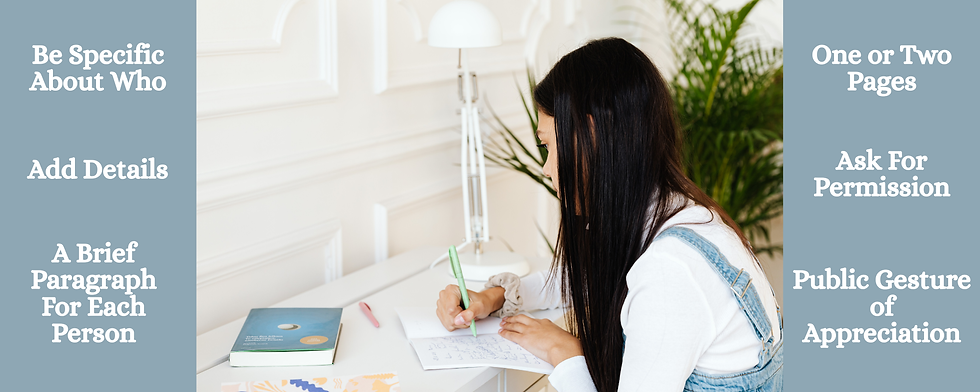
Parameters for Devising an Acknowledgement Page
Decide who you want to acknowledge and be specific.
Add details about their involvement.
Keep it concise—a few lines or a brief paragraph for each person. Aim for one to two pages.
The most common placement is at the end of the novel before the author bio.
It can also be placed before the table of contents or after the preface.
It is a traditional part of a published book.
This page serves as a public gesture of appreciation.
Ask for permission to include someone.
You can list your acknowledgements by order of importance—whatever that means to you.
Make it Your Own
Weave your personality into each acknowledgement—(Name) Thank you for listening to my late-night rambles about my story and its characters.
Maintain a genuine tone throughout in your authentic voice—(Name) You believed in this story and saw its heart and soul. It was a privilege to work with you.
Don’t be afraid to add humor—(Name) Thank you for keeping me fed and watered during long writing days.
Avoid stiff or formal language—(Name) Please accept my undying gratitude for your assistance with this novel.


